demos
Everything runnable, grouped by what you actually want to
do: see whether it works, put real data in, or check the
claims yourself — including the attacks we run against our own design.
# all of these assume the package and, optionally, the public network
git clone https://github.com/alviso/blindrange && cd blindrange
python3 -m venv .venv
.venv/bin/pip install --upgrade pip && .venv/bin/pip install -e .
# then run the demos with .venv/bin/python3. A venv is not politeness:
# most current Pythons refuse to install into the system one at all.
See whether it works
Sixty seconds, no account, nothing stored anywhere you care
about.
Encrypted orders, three panels
One screen with your view, the network's view, and buttons
that kill nodes while you query. The fastest way to understand what
this is: the same rows are readable on the left and pseudorandom on the
right, and killing a node changes neither.
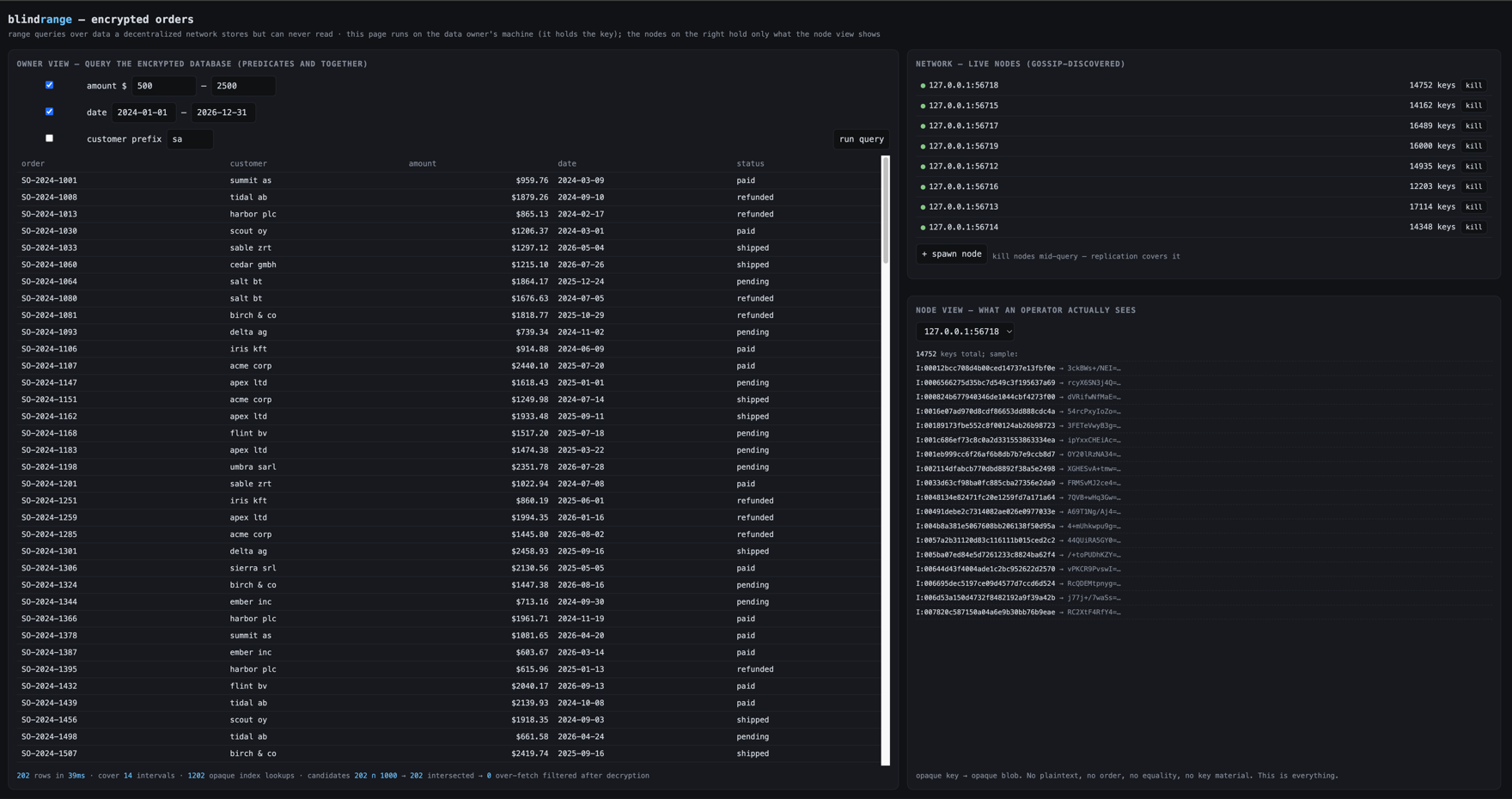
python3 examples/webdemo/app.py # → http://127.0.0.1:8600
contrast.py
The same thing without a browser: prints what the owner
reads beside what the network stores.
python3 examples/contrast.py
The live network running now
Three nodes across two continents, self-reported key
counts next to proved possession, and each node's share of a
distribution pool.
python3 examples/whos_here.py # the same roster, from a terminal
Put real data in
These are the ones shaped like something you might actually
run.
blindrange-audit — an audit trail its host cannot read
The workload where this design wins on the merits rather
than as a privacy tax: append-only is what the index already is, and
tamper-evidence falls out of per-record AEAD. Ships from Vector, Fluent
Bit or the OpenTelemetry Collector with configuration alone — no plugin
to write.
python3 examples/auditlog/audit.py --state ~/.blindrange/audit.brdb
# → http://127.0.0.1:8710
S3-compatible gateway
Point anything that already writes to S3 at
storage that cannot read it — backup tools, compliance archivers, Loki,
rclone. Verified against boto3 including multipart, prefix and delimiter
listings, and SigV4.
python3 examples/s3gateway/gateway.py --state ~/.blindrange/s3.brdb
# → http://127.0.0.1:8720, path-style addressing
Off-site backup with a searchable catalog
Plain boto3, no blindrange imports at all — it
would work unchanged against AWS. It exists to show the gap: plain S3 gives
you a catalog and a provider who reads everything; encrypting before upload
takes the catalog with it. This keeps both, because a prefix listing is an
index lookup over encrypted keys.
python3 examples/s3backup/backup.py backup ~/src --bucket work
python3 examples/s3backup/backup.py find work --name '*.py' --since 1h
python3 examples/s3backup/backup.py what-they-see work
The client app
Drop a CSV in, get a schema with an honest one-sentence
description of what it leaks, then query it. For when you want your own
data in without writing code.
blindrange init      # schema wizard
blindrange ui        # → http://127.0.0.1:8700
Check the claims
The part most projects don't ship. If the disclosures are
only as good as our willingness to run the attacks, you should be able to run
them too.
The attack harness
Runs the real attacks from the literature against our own
design and prints the numbers — snapshot equality, frequency inference, and
an ML query-watcher. It is how we know
leaf_width bounds
reconstruction by construction rather than by hope.python3 prototype/attack.py
python3 prototype/bounded_demo.py # the leaf-width bound, measured
verify_log.py checks us
We compute the payout shares, which makes us the one
party you'd otherwise have to trust. This remembers the log's tree head and
demands proof, next run, that nothing already published has changed.
Tested by actually cheating: rewriting a past share from 333 to 900 is
rejected.
python3 examples/verify_log.py
  consistent with the 2 entries seen previously  ✓  (1 new)
Benchmarks
Ingest and delete, run against the real public network
rather than localhost — which is where every interesting bug turned up.
python3 examples/bench_logs.py --records 100000
python3 examples/bench_delete.py --state my.brdb
What none of these are. This is a research
prototype on a demo network with no durability promises. Run your own nodes
for anything you would mind losing, and read the
threat
model first — it is explicit that this is not for healthcare or
high-stakes PII, and why.